
 AT A GLANCE
Executive Comparison
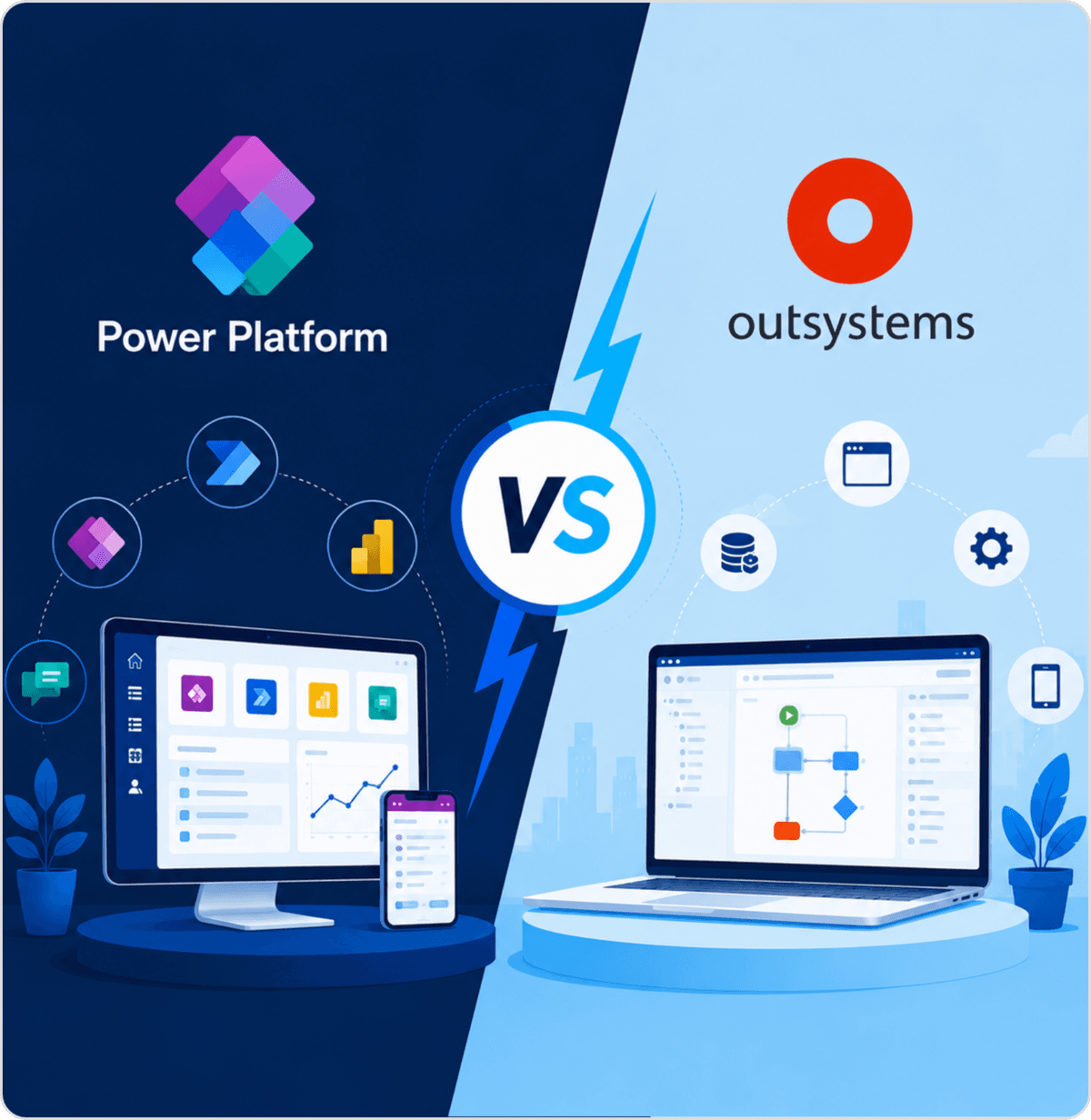
Both platforms accelerate application delivery. The better choice depends on ecosystem alignment, application complexity, developer control, governance, and the operating model behind the build.
| EVALUATION FACTOR | POWER PLATFORM | OUTSYSTEMS | BEST FIT |
|---|---|---|---|
| Development Speed | Very Fast | Fast | Depends |
| Microsoft Integration | Native | Connector / Integration | 🏆Power Platform |
| Pro-Code Extensibility | Strong | Very Strong | OutSystems |
| Citizen Development | Core Strength | More Developer-Led | 🏆Power Platform |
| Enterprise Governance | Strong | Strong | Depends |
| AI Integration | Copilot Ecosystem | AI Capabilities Available | Depends |
| Microsoft Estate Fit | Excellent | Good | 🏆Power Platform |
| Best Fit | Microsoft-Centered Business Apps | Complex Custom Applications | Depends |
IN-DEPTH ANALYSISLow-Code Is Not One Category
The critical distinction is not simply how quickly developers can build. It is who builds, what is being built, how deeply it must integrate, and who will own the application five years from now.
Microsoft-Native Development
Power Apps, Power Automate, Dataverse, Power BI, Teams, and Microsoft 365 can operate as a connected application and workflow layer.
Citizen + Pro-Code Model
Business teams can solve smaller problems while professional developers handle complex architecture, integrations, and extensions.
Fast Workflow Automation
Power Automate provides a direct path from process discovery to approval, notification, integration, and business workflow automation.
Enterprise Governance
Organizations can establish environments, security, identity, data policies, and lifecycle controls around application development.
Developer-Centric Application Engineering
OutSystems is designed for teams building sophisticated applications that require strong developer control and custom logic.
Complex Application Support
The platform can be a strong fit where applications require deeper custom behavior than simple internal workflow applications.
Platform Independence
Organizations that do not want their application strategy tightly coupled to one productivity ecosystem may value the platform's broader positioning.
Enterprise Delivery Model
A structured professional development model can suit organizations with dedicated application engineering teams and formal release processes.
IMPLEMENTATION MILESTONESApplication Delivery Timeline
Illustrative delivery paths. The real variable is application complexity, not the label 'low-code'.
Process & Architecture
Define the user journey, business rules, data model, integrations, security, and governance boundaries.
Application Development
Build Power Apps, Power Automate workflows, Dataverse components, dashboards, and integrations.
Testing & Governance
Validate security, permissions, performance, business rules, user acceptance, and deployment controls.
Launch & Adoption
Deploy, monitor adoption, measure workflow outcomes, and optimize the application based on real usage.
OutSystems Roadmap
Architecture Planning
Define application architecture, data domains, integrations, environments, security, and deployment strategy.
Application Development
Develop the application, custom logic, interfaces, integrations, and supporting services.
Testing & Optimization
Complete functional, integration, security, performance, and user acceptance testing.
Rollout & Governance
Deploy, establish monitoring, manage releases, and continuously optimize application performance.
DECISION GUIDEWhich Platform Should You Choose?
Choose Power Platform
Strong fit when your organization already relies on Microsoft 365, Azure, Teams, Dynamics, Power BI, or other Microsoft services and wants fast workflow and application delivery.
✨ Best Fit:
- •Internal business applications
- •Workflow and approval automation
- •Microsoft-centered organizations
- •Citizen + professional development
Choose OutSystems
Strong fit when the primary requirement is sophisticated custom application engineering with extensive developer control and less dependence on a single productivity ecosystem.
⚠️Evaluate platform cost, application complexity, developer availability, governance, and long-term operating model before committing.
FAQFrequently Asked Questions
It can be a strong choice when developer-led application engineering and deep custom logic are central requirements. The decision should still be based on architecture, cost, team capability, and ecosystem fit.
Power Platform is usually the more natural fit because it integrates directly with Microsoft's identity, productivity, data, analytics, automation, and AI ecosystem.
For many internal workflows and business applications, yes. For highly differentiated products, demanding external applications, or unusual technical requirements, custom engineering may remain the better architecture.