
 AT A GLANCE
Executive Comparison
A practical comparison of the factors that usually determine whether an ERP investment creates business value or implementation drag.
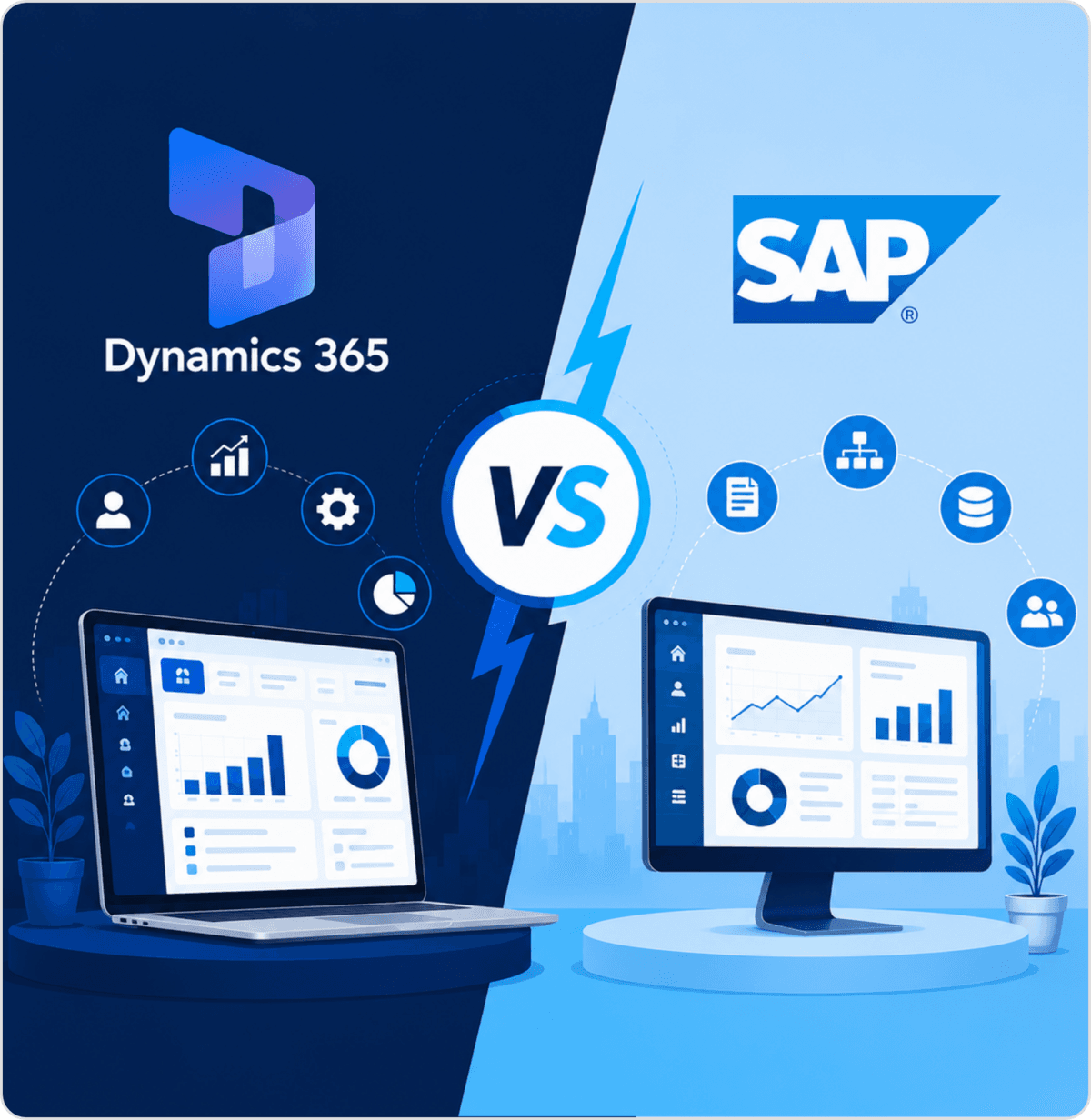
| EVALUATION FACTOR | MICROSOFT DYNAMICS 365 | SAP S/4HANA | BEST FIT |
|---|---|---|---|
| Implementation Complexity | Moderate | High | 🏆Dynamics 365 |
| Enterprise Scale | Strong | Very Strong | Depends |
| Cloud-First Architecture | Native SaaS Options | Cloud + Hybrid Options | Depends |
| Embedded AI | Copilot + Microsoft AI | SAP Business AI | Depends |
| Microsoft Ecosystem | Native | Integration Required | 🏆Dynamics 365 |
| Deep Process Customization | Low-Code + Pro-Code | Highly Extensive | SAP |
| Time to Business Value | Typically Faster | Typically Longer | 🏆Dynamics 365 |
| Best Fit | Mid-Market to Enterprise | Complex Global Enterprise | Depends |
IN-DEPTH ANALYSISThe Real Trade-Off
The decision is rarely about which ERP has more features. It is about implementation burden, operating model, existing architecture, governance requirements, and the speed at which the business needs measurable value.
Faster Business Application Layer
Dynamics 365 works closely with Power Platform, Microsoft 365, Azure, and Copilot, reducing the distance between ERP data and operational workflows.
Lower-Code Extension Model
Power Apps, Power Automate, Dataverse, and pro-code extensions allow teams to adapt processes without treating every change as a large ERP customization.
Unified Microsoft Ecosystem
Organizations already invested in Microsoft can connect ERP, CRM, productivity, analytics, identity, and AI through a common ecosystem.
Operational Visibility
Power BI and connected operational data can shorten the distance between transaction data, management reporting, and executive decisions.
Deep Enterprise Process Coverage
SAP is designed for complex, global operating models with extensive financial, supply-chain, manufacturing, asset, and compliance requirements.
Global Operating Model
Large multinational organizations can benefit from mature capabilities for multi-entity, multi-country, and highly structured enterprise operations.
Deep Customization
Complex business requirements can be represented through extensive configuration and development capabilities.
Large Enterprise Ecosystem
SAP has a mature global partner and implementation ecosystem for organizations operating at substantial scale.
IMPLEMENTATION MILESTONESRoadmap & Time to Business Value
Illustrative delivery paths. Actual timelines depend on scope, data quality, integrations, governance, geography, and organizational readiness.
Discovery & Architecture
Map critical processes, data domains, integrations, users, controls, and measurable business outcomes.
Configuration & Build
Configure core modules, automate priority workflows, establish integrations, and prepare the data model.
Testing & Adoption
Complete UAT, security validation, data migration, role testing, training, and operational readiness.
Go Live & Optimization
Launch in controlled waves, measure adoption and process performance, then optimize the highest-friction workflows.
SAP S/4HANA Roadmap
Blueprint & Design
Define global processes, organizational structures, controls, data architecture, and transformation scope.
Configuration & Development
Configure the core platform, develop required extensions, build integrations, and prepare migration waves.
Testing & Change Readiness
Run integration testing, data validation, user acceptance, security controls, training, and cutover rehearsals.
Deployment & Stabilization
Execute cutover, stabilize critical processes, resolve exceptions, and establish continuous optimization.
DECISION GUIDEAlready Running SAP?
Keep SAP & Optimize
If SAP already supports critical global processes reliably, a replacement is not automatically justified. Improve workflow visibility, integrations, reporting, and automation around the existing core.
⚠️Avoid migration for migration's sake. The business case must account for disruption, data migration, training, integration, and change-management costs.
Modernize in Controlled Waves
Where the current architecture is creating measurable operational drag, modernize priority workflows first while protecting critical financial and operational continuity.
✨ Phased Modernization:
- •Start with the highest-cost workflow constraint.
- •Keep proven core processes stable while modernizing adjacent execution layers.
- •Measure cycle time, exception rates, adoption, and operating cost before expanding the program.
FAQFrequently Asked Questions
There is no universal number. Total cost depends on licenses, implementation, customization, integrations, data migration, infrastructure, internal teams, and ongoing support. Compare the full lifecycle cost rather than license price alone.
Yes. Many organizations can improve workflows, reporting, automation, and integrations around an existing ERP before considering a core replacement.
Start with business-critical workflows, current operating cost, data quality, integration dependencies, reporting latency, user adoption, and the financial impact of the current constraints.