 AT A GLANCE
Executive Comparison
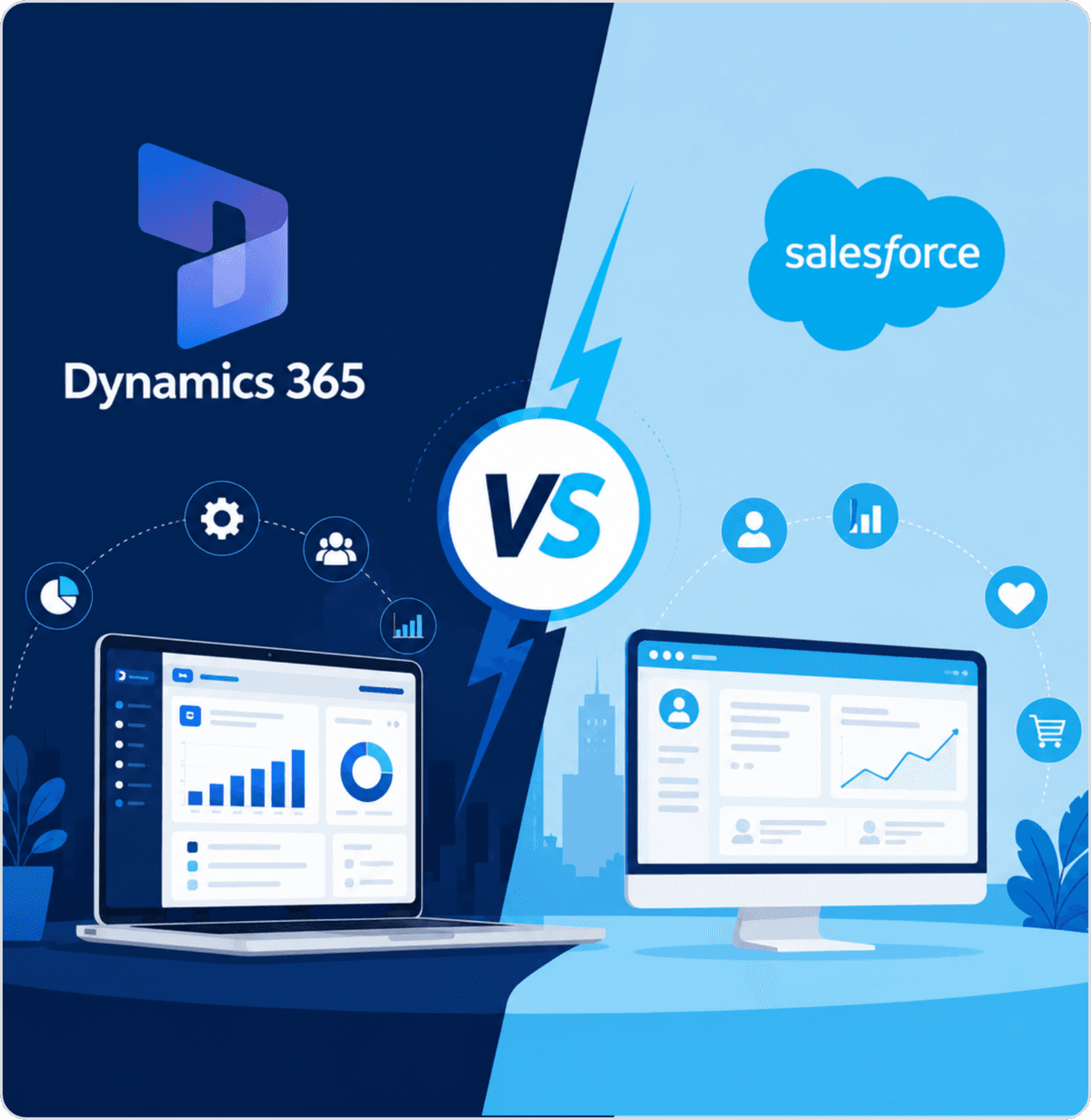
The decision changes depending on whether you need a Microsoft-centered business platform or a CRM-first ecosystem with extensive specialist depth.
| EVALUATION FACTOR | MICROSOFT DYNAMICS 365 | SALESFORCE | BEST FIT |
|---|---|---|---|
| CRM Capability | Enterprise Grade | Enterprise Grade | Tie |
| Microsoft 365 Integration | Native | Integration Required | 🏆Dynamics 365 |
| AI | Copilot + Microsoft AI | Einstein + Data Cloud | Depends |
| Workflow Automation | Power Platform | Salesforce Automation | Depends |
| ERP Integration | Native Dynamics ERP Path | External ERP Ecosystem | 🏆Dynamics 365 |
| Customization | Low-Code + Pro-Code | Highly Extensible | Tie |
| Best Fit | Microsoft-Centered Operations | CRM-Centric Enterprises | Depends |
IN-DEPTH ANALYSISCRM Is Only One Part of the Decision
Both platforms can support sophisticated CRM operations. The larger question is what sits around the CRM: ERP, productivity, analytics, automation, data, AI, and the systems your teams already use.
Microsoft-Native Operating Model
Teams already using Microsoft 365, Teams, Azure, Power BI, and Power Platform can build a more connected operating environment around Dynamics 365.
CRM + ERP Path
Dynamics can connect customer processes with finance and supply-chain capabilities without making the CRM a standalone island.
Power Platform Extension
Power Apps and Power Automate provide a practical route for building business applications and workflows around the core CRM.
Embedded Analytics
Power BI provides a mature path from CRM and operational data to management reporting and executive decision-making.
CRM Depth
Salesforce provides extensive capabilities for sales, service, marketing, customer data, and specialized CRM workflows.
Large App Ecosystem
The Salesforce ecosystem provides a broad range of extensions for specialized business requirements.
Sales Automation
Strong pipeline, opportunity, forecasting, account, and sales productivity capabilities support complex commercial organizations.
Extensive Platform
Organizations with mature Salesforce teams can build sophisticated applications and workflows around the Salesforce platform.
IMPLEMENTATION MILESTONESRoadmap & Time to Value
Illustrative delivery paths. Actual timelines vary materially with data migration, customization, integrations, governance, user count, and process complexity.
Discovery & Process Design
Map customer journeys, sales processes, service workflows, data ownership, integrations, and measurable outcomes.
Configuration & Integration
Configure CRM, security, workflows, integrations, reporting, and required extensions.
Migration & Adoption
Validate data, complete UAT, train users, establish governance, and prepare production cutover.
Launch & Optimize
Measure adoption, pipeline hygiene, cycle time, automation performance, and user friction after launch.
Salesforce Roadmap
Discovery & Architecture
Define CRM requirements, sales and service processes, data model, integrations, and governance.
Configuration & Build
Configure core clouds, workflows, security, data services, and required ecosystem integrations.
Testing & Migration
Validate processes, migrate data, complete UAT, and prepare users for production.
Go Live & Adoption
Launch, monitor adoption and data quality, and continuously refine sales and service workflows.
MIGRATION STRATEGYAlready Using Salesforce?
Continue with Salesforce
If Salesforce is deeply embedded, adopted, and producing acceptable business outcomes, replacement should require a quantified business case—not a platform preference.
⚠️Evaluate integration overhead, licensing, customization debt, data architecture, user adoption, and the cost of changing platforms before deciding.
Evaluate a Dynamics 365 Transition
A Microsoft-centered organization may benefit from consolidating CRM, ERP, analytics, workflow automation, productivity, and AI into a more connected operating environment.
✨ Potential Migration Benefits:
- •Connect CRM with Dynamics ERP and Power Platform.
- •Reduce duplicate integrations across Microsoft workloads.
- •Use Power BI and Microsoft AI within the wider operating stack.
FAQFrequently Asked Questions
License price alone is not enough. Compare the complete cost of licenses, implementation, integrations, customization, administration, analytics, automation, support, and change management.
Only when the quantified business case supports it. Start by comparing current operating friction and total cost against the expected value of the target architecture.
Yes. Dynamics 365 can integrate with external applications through APIs, connectors, middleware, and custom integration patterns. The right architecture depends on security, data ownership, latency, and process requirements.