

 AT A GLANCE
Executive Comparison
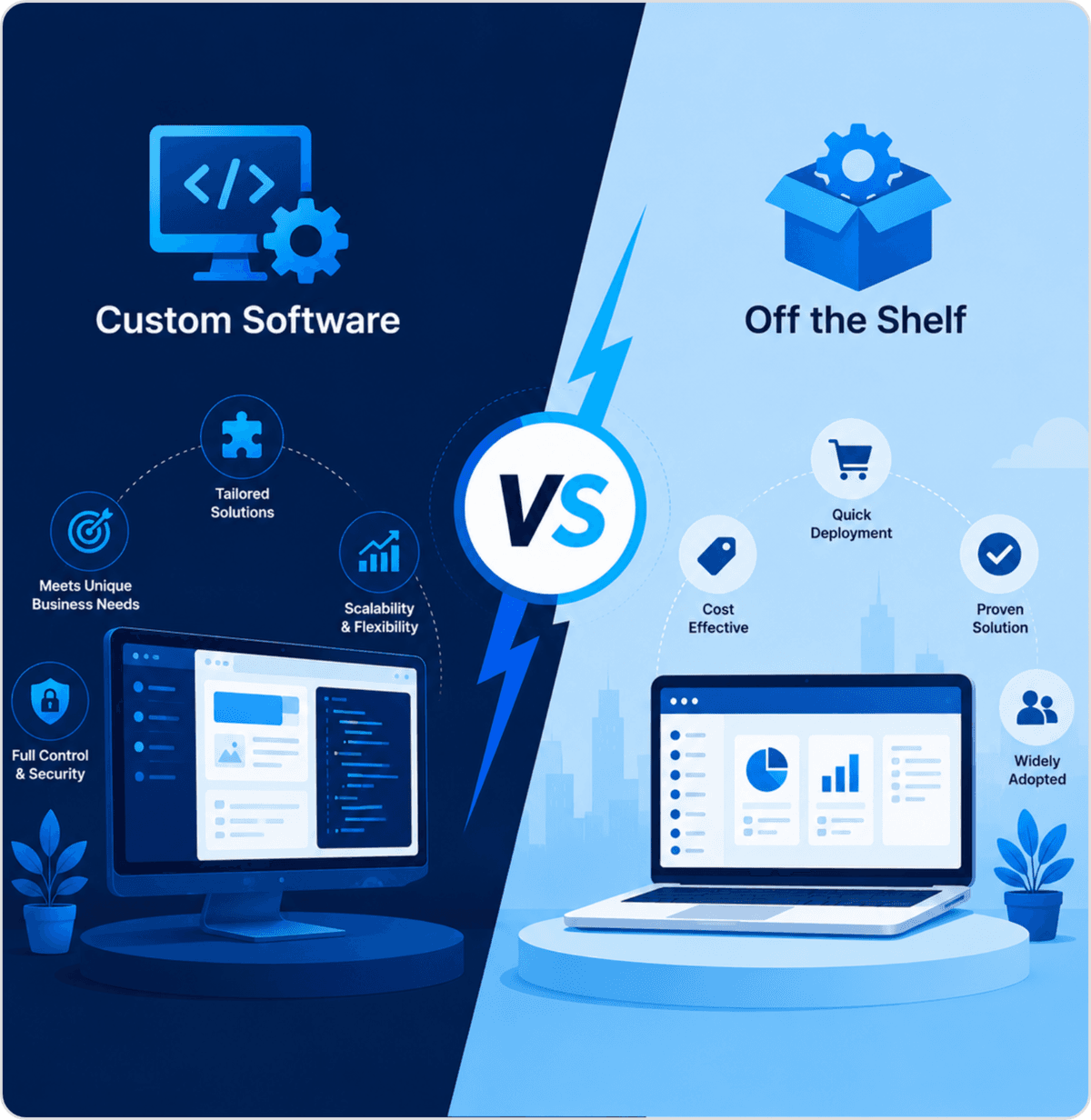
The right answer is rarely 'always build' or 'always buy'. It depends on whether the workflow is standard, strategic, differentiated, or too expensive to keep adapting around.
| EVALUATION FACTOR | CUSTOM SOFTWARE | OFF-THE-SHELF | BEST FIT |
|---|---|---|---|
| Implementation Speed | Slower | Faster | Off-the-Shelf |
| Process Fit | Exact | Standardized | 🏆Custom |
| Flexibility | Very High | Product-Bound | 🏆Custom |
| Upfront Investment | Higher | Lower | Off-the-Shelf |
| Recurring License Cost | Architecture Dependent | Subscription / License | Depends |
| Differentiation | High | Limited by Product | 🏆Custom |
| Vendor Dependency | Lower | Higher | 🏆Custom |
| Time to Value | Medium-Term | Short-Term | Depends |
IN-DEPTH ANALYSISBuild vs Buy Is a Business Decision
The expensive mistake is not choosing the wrong category. It is buying software that forces the business to redesign a strategically important process—or building software for a process that is already standardized.
Built Around the Operating Model
The application can reflect your actual workflows, decision rules, approvals, data structures, and customer experience instead of forcing the organization into generic product assumptions.
Strategic Differentiation
If a workflow creates competitive advantage, owning the software behind it can turn operational know-how into durable organizational capability.
Controlled Roadmap
Product priorities are driven by the business rather than a vendor's roadmap, packaging decisions, or licensing strategy.
Deep Integration
Custom systems can be designed around existing ERP, CRM, data, APIs, devices, and operational workflows from the start.
Fast Time to Value
Mature commercial software can deliver proven functionality without funding a full product development lifecycle.
Lower Initial Risk
Buying an established product transfers much of the initial product development, maintenance, security, and release burden to the vendor.
Proven Functionality
Established products often include mature features, integrations, documentation, support, and implementation patterns.
Predictable Product Evolution
Vendors continuously invest in security, functionality, infrastructure, and product updates without requiring the customer to build every capability internally.
IMPLEMENTATION JOURNEYTime to Business Value
A useful build-vs-buy analysis compares not only launch speed, but the cumulative cost of adaptation, integration, licenses, maintenance, manual work, and future change.
Discovery & Business Case
Map the workflow, quantify operating friction, define requirements, assess build-versus-buy economics, and establish success metrics.
Product Design & Engineering
Design the experience, build the application, develop integrations, establish security, and implement core workflows.
Testing & Adoption
Complete functional, security, performance, integration, and user acceptance testing before production rollout.
Launch & Continuous Improvement
Measure adoption and business outcomes, then prioritize changes against value rather than feature volume.
Off-the-Shelf
Market & Product Selection
Define requirements, evaluate products, validate integrations, assess security, and select the strongest functional fit.
Configuration
Configure users, workflows, permissions, integrations, reporting, and standard business settings.
Migration & Validation
Migrate data, validate business processes, complete UAT, train users, and resolve configuration gaps.
Go Live & Optimize
Launch the product, monitor adoption, and identify where configuration, integration, or process redesign is still required.
DECISION GUIDEWhen Should You Build?
Buy When the Process Is Standard
If the process is not a competitive differentiator and a mature product already solves it well, buying is usually the faster and lower-risk route.
✨ Buy When:
- •The workflow is industry-standard.
- •Time to value matters more than differentiation.
- •A mature product meets most requirements without excessive customization.
- •Internal engineering capacity should remain focused on strategic systems.
Build When the Workflow Is Strategic
Custom engineering becomes more rational when the process is commercially important, poorly served by available products, or expensive to keep bending around generic software.
⚠️
FAQFrequently Asked Questions
Buy when the capability is standardized, mature products meet the requirement, speed matters, and the process is not a strategic differentiator.
Build when the workflow is strategically important, poorly served by existing products, highly differentiated, integration-heavy, or expensive to keep adapting around off-the-shelf software.
Yes. A hybrid architecture is often strongest: buy commodity capabilities such as CRM or ERP, then build the differentiated workflow, orchestration, portals, analytics, or automation layer around them.