
 AT A GLANCE
Executive Comparison
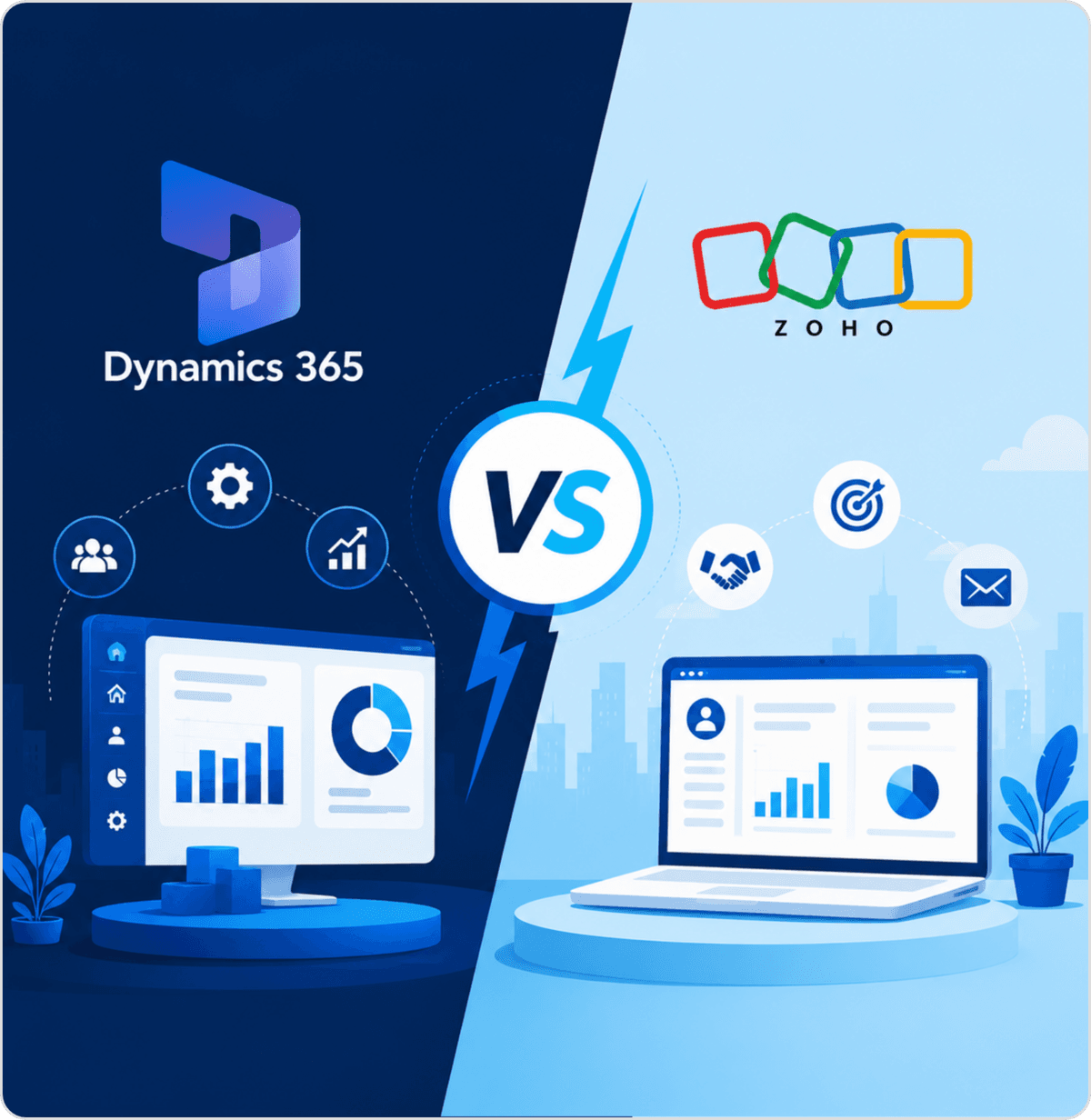
A practical comparison for organizations deciding between a faster, lighter CRM stack and a broader enterprise business platform.
| EVALUATION FACTOR | MICROSOFT DYNAMICS 365 | ZOHO | BEST FIT |
|---|---|---|---|
| Implementation Speed | Moderate | Fast | Zoho |
| CRM Capability | Enterprise Grade | Strong SMB-Mid-Market | Depends |
| ERP & Operations | Broad Native Portfolio | Broader Suite, Lighter Depth | 🏆Dynamics 365 |
| Microsoft Ecosystem | Native | Integration Based | 🏆Dynamics 365 |
| AI | Copilot + Microsoft AI | Zia AI | Depends |
| Entry Cost | Higher | Lower | Zoho |
| Enterprise Scalability | Very Strong | Strong for Mid-Market | 🏆Dynamics 365 |
| Best Fit | Growing / Enterprise Operations | SMB / Cost-Conscious Growth | Depends |
IN-DEPTH ANALYSISSpeed vs Operating Depth
Zoho can be highly practical when the organization values fast deployment and lower entry cost. Dynamics 365 becomes more compelling as operational complexity, Microsoft dependency, governance, and cross-functional requirements increase.
Broader Business Platform
Dynamics 365 can extend beyond CRM into finance, supply chain, customer service, sales, field service, and connected operational workflows.
Microsoft-Native Integration
Organizations already standardized on Microsoft 365, Azure, Power BI, Teams, or Power Platform can reduce integration friction.
Enterprise Governance
A larger enterprise architecture provides more options for identity, security, data governance, analytics, and workflow orchestration.
AI and Automation Path
Copilot and Power Platform provide a path from CRM data to automation and AI-assisted business processes.
Fast Deployment
Zoho can be practical for organizations that need a capable CRM and business application suite without a large transformation program.
Lower Entry Cost
A comparatively accessible pricing model can make adoption easier for smaller and cost-sensitive teams.
Broad Application Suite
CRM, finance, support, marketing, HR, and productivity applications can be assembled within the Zoho ecosystem.
Accessible Administration
The platform can be easier for smaller teams to configure and operate without a large specialist technology organization.
IMPLEMENTATION MILESTONESRoadmap & Time to Value
Illustrative pathways. Actual delivery depends on requirements, integrations, data quality, user count, customization, and change management.
Discovery & Fit Assessment
Map processes, requirements, existing systems, data, integrations, security, and expected outcomes.
Configuration & Integration
Configure CRM and related workloads, automate priority processes, and establish integrations.
Testing & Adoption
Validate data, complete UAT, train users, establish governance, and prepare the production cutover.
Launch & Optimization
Measure adoption, workflow performance, data quality, and business outcomes after launch.
Zoho Roadmap
Requirements & Data Review
Define CRM requirements, users, workflows, data sources, and migration needs.
Configuration
Configure modules, fields, workflows, permissions, reports, and required integrations.
Validation & Training
Validate processes, migrate data, train users, and resolve adoption issues.
Go Live & Improve
Launch production workflows and optimize based on adoption, data quality, and business feedback.
GROWTH STRATEGYAlready Using Zoho?
Continue with Zoho
If Zoho meets your current CRM, finance, support, and workflow requirements at an acceptable cost, staying may be the most rational decision.
⚠️Review whether growing integration requirements, process complexity, reporting limitations, or governance needs are creating a measurable operating constraint.
Upgrade to Dynamics 365
For organizations moving toward more complex operations, Dynamics 365 can provide a broader Microsoft-centered foundation across CRM, ERP, analytics, automation, and AI.
✨ Potential Migration Benefits:
- •Connect CRM, ERP, analytics, workflow, and productivity more closely.
- •Create a stronger enterprise data and governance foundation.
- •Use Power Platform and Copilot across cross-functional workflows.
FAQFrequently Asked Questions
Not necessarily. The right implementation can start with a focused business scope and expand as value is proven. Complexity comes more from scope and architecture than from company size alone.
Only if the current platform is creating measurable business constraints. Quantify the cost of those constraints and compare it with migration cost and expected value before deciding.
Dynamics 365 generally provides greater enterprise breadth, while Zoho can remain highly effective for organizations with simpler operating models. Fit should be judged against the next three to five years of process complexity.